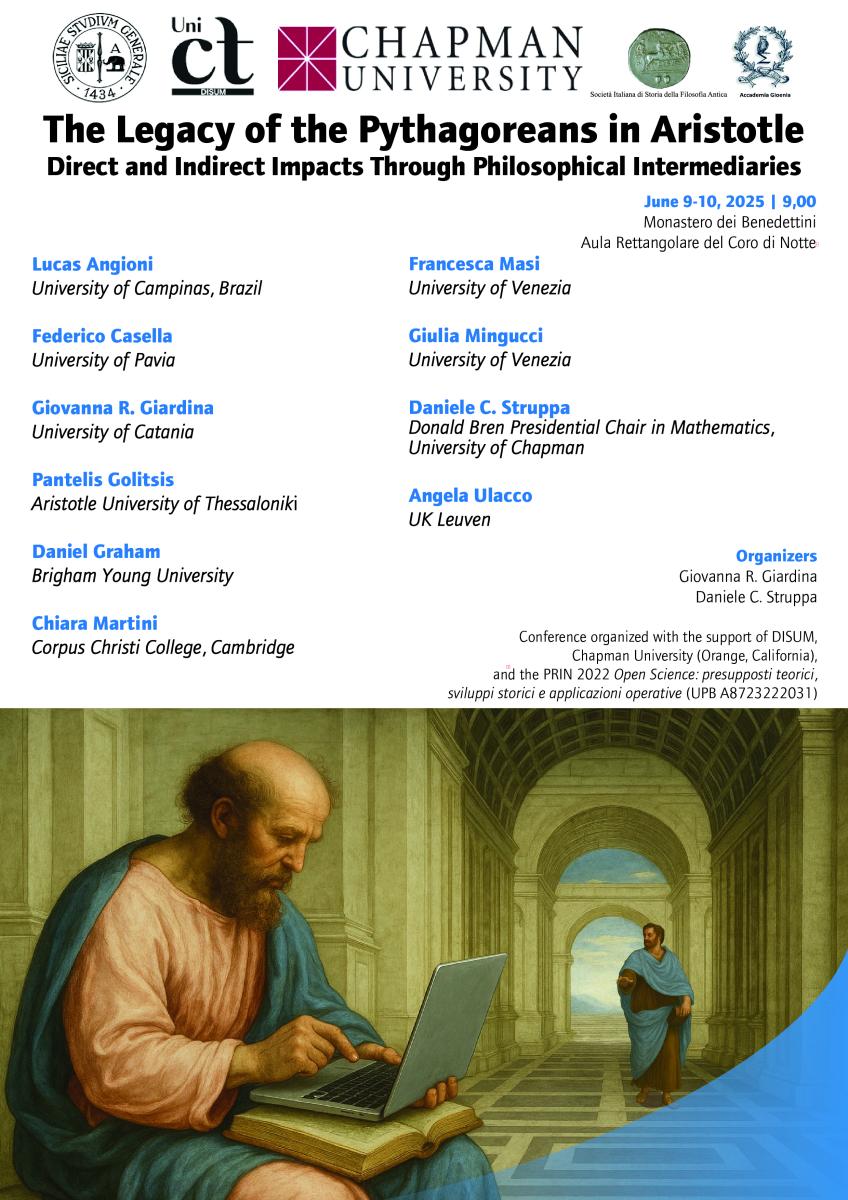
The Legacy of the Pythagoreans in Aristotle. Direct and Indirect Impacts through Philosophical Intermediaries.
The Legacy of the Pythagoreans in Aristotle. Direct and Indirect Impacts through Philosophical Intermediaries.
Catania, 9th-10th June 2025, Department of Humanities
Organizers: G.R. Giardina (University of Catania), D.C. Struppa (Chapman University)
The aim of this conference is that of thoroughly exploring the influence of Pythagorean thought on Aristotle’s philosophy. Aristotle studied the Pythagorean doctrine extensively, dedicating several works to it. His interest was not limited to a direct engagement: Aristotle frequently references the Pythagoreans, either to support theoretical positions he shared with them (e.g. Cael. I 1) or to criticize them in a rigorous and structured manner (e.g. Metaph. A 8, N 3). Moreover, an experienced reader of Aristotelian texts can discern the influence of Pythagorean philosophy—at times in implicit contexts—shaping the way Aristotle formulates arguments and resolves theoretical problems.
In addition, the influence of Pythagoreans extended further the Pythagoreanism, profoundly shaping other philosophers. This is evident in Plato and the Academy, but early Greek thinkers, such as the Eleatics, may have engaged with various aspects of Pythagorean philosophy, too.
The first purpose of the conference is that of reconstructing and assessing whether and to what extent Aristotle saw the legacy of Pythagorean philosophy on other philosophers and how this shows through his engagement with them.
Furthermore, and as is well known, at least from the Imperial period some readers of Aristotle had an interest in setting him within a tradition of Pythagorean thought, to the point of seeing some of his writings (notably: the Categories) as deriving from Pythagorean sources. An additional purpose of the conference is that of casting light on this aspect of the reception of Aristotle, assessing its problems and merits in a more systematic way than has been attempted so far.