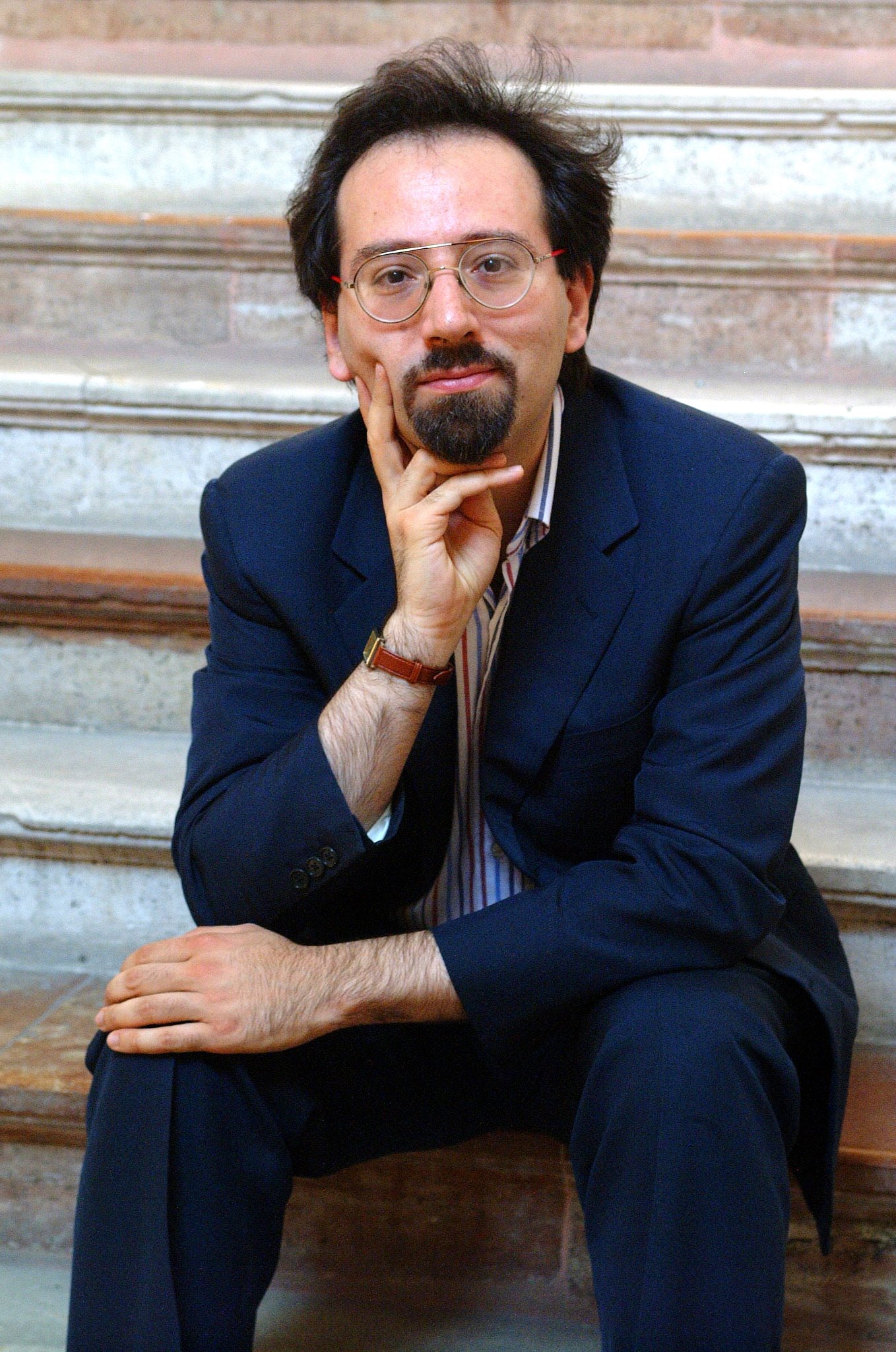
Alessandro MASTROPIETRO
Alessandro Mastropietro (L’Aquila, 1968) graduated in Composition, Electronic Music and Orchestral Conducting at Conservatorio ‘A, Casella’, L’Aquila. He obtained his Master Degree through a final work about Luigi Nono’s late music with live electronics, and later – in 2005 – his PhD (dissertation title: Nuovo Teatro Musicale tra Roma e Palermo, 1961-1973, published – enlarged and updated – in 2020, LIM) from the University ‘La Sapienza’ in Rome. He is now Research professor in Musicology at the University of Catania, where he is also member of Professors' board for PhD course in Sciences for Cultural Heritage and Production. His research is primarily focused on: 1) the music of the last 60 years, with emphasis on experimental music theatre in Italy; 2) instrumental music from the second half of the eighteenth century, especially Boccherini’s works and the output for two violins and bass/cello from 1740 onward. He has edited the critical edition of D. Guaccero’s writings within ‘Le Sfere’ series, and volumes on composers Paolo Renosto (2013) and Francesco Pennisi (2014). He was Unity Coordinator within an Italian National Research about the digital cataloguing of musical works in the second half of twentieth century. His articles and papers are regularly accepted for publication and presentation by international scientific reviews/volumes and conferences.
For further details on publications, research and scientific activities, please see the attachment in the field Curriculum and the other fields.
Alessandro Mastropietro (L’Aquila, 1968) studied Composition, Electronic Music, and Orchestral Conducting at the Conservatory of his native city. He graduated from Sapienza University of Rome under the supervision of Pierluigi Petrobelli, with a thesis on Luigi Nono. He is currently Associate Professor of Musicology and Music History at the University of Catania.
His research focuses primarily on musical composition of the last sixty years, particularly the neo-avant-garde movements associated with the Roman cultural milieu. He devoted both his doctoral research and a substantial monograph—Nuovo teatro musicale fra Roma e Palermo, 1963–1971 (LIM, 2020)—to the musical theatre produced within this context. He also specializes in late eighteenth-century instrumental music, with particular emphasis on the works of Luigi Boccherini and on the repertoire for trio consisting of two violins and cello.
He has presented papers at numerous international conferences and has published extensively, including contributions in English to conference proceedings. His research has appeared regularly in leading national and international scholarly journals, including Contemporary Music Review, Boccherini Studies, Studi Musicali, Chigiana, Fonti Musicali Italiane, Musica/Realtà, and Archival Notes, as well as in edited volumes.
He prepared the critical edition of the writings of Domenico Guaccero for the series Le Sfere and has edited monographic volumes on Paolo Renosto and Francesco Pennisi for LIM. He also contributed three biographical entries to the second edition of Die Musik in Geschichte und Gegenwart, one of the leading international reference encyclopedias in musicology.
He serves as Scientific Director and General Editor of the new critical edition of the works of Franco Evangelisti, a project jointly undertaken by the Fondazione Isabella Scelsi (Rome) and Pizzicato Verlag Helvetia. The first volume of the edition, 4! for Violin and Piano, was published in 2026. He has also served as Principal Investigator of a research unit within a PRIN (Projects of National Interest) programme dedicated to the digital realization of thematic catalogues of musical works, focusing on case studies involving composers of the second half of the twentieth century.
(June 2026)
Last edit: 05/31/2026
In recent years, my research has focused primarily on Italian musical neo-avant-garde production during the third quarter of the twentieth century, with particular attention to composers active in Rome and Palermo—two major centers of musical innovation—and to the intellectual, institutional, and interdisciplinary contexts in which their work developed.
Within this framework, my research has addressed the following themes and methodological issues:
1. New musical dramaturgies, understood as the interaction and reciprocal action of all performative and media components, including audience participation (following Eugenio Barba’s concept of dramaturgy).
This perspective has involved:
- an interdisciplinary approach, both in the genesis of the works under study—often resulting from collaborative processes involving composers, visual artists, stage designers, theatre directors and actors, choreographers, filmmakers, and occasionally writers—and in the investigation of heterogeneous source materials. Such collaborations frequently challenged traditional distinctions between genres, artistic competencies, and expressive media, while questioning the conventional primacy of music within musical dramaturgy;
- a focus on the notion of the performance text and its material traces, viewed as essential for reconstructing the textual constellation of a work. This has required extensive archival research in numerous public and private collections, including verbal, photographic, and audiovisual documents preserved on a variety of media;
- an examination of the processes of renegotiation among authors, performers, audiences, and institutions within the new forms of sociality that characterized the 1960s and 1970s.
The musical theatre works of composers such as Franco Evangelisti, Domenico Guaccero, Sylvano Bussotti, Egisto Macchi, Aldo Clementi, Mario Bertoncini, Vittorio Gelmetti, Francesco Pennisi, and Marcello Panni can, mutatis mutandis, be interpreted through the expanded category of postdramatic musical theatre (Hans-Thies Lehmann), both in its genealogical dimension (deconstruction and reconstruction of dramaturgical elements) and in its typological dimension (media self-referentiality). My principal contribution to this field is the monograph Nuovo Teatro Musicale fra Roma e Palermo, 1961–1973 (Lucca: LIM, 2020). A further monograph devoted to Bertoncini’s “theatre of reality” is forthcoming.
2. The status of the musical opus, considered from both textual and material perspectives, with particular attention to the redefinition of formal categories, compositional processes, performance practices, and technological supports.
Research on Franco Evangelisti and Domenico Guaccero has focused on:
- the identity of the musical work as emerging from a complex textual constellation rather than from a single authoritative text;
- the transformation of the traditional concept and structure of the catalogue of works;
- compositional processes investigated through sketch studies;
- critical editions of late twentieth-century music, especially the works of Franco Evangelisti.
A further line of research concerns instrumental music from the second half of the eighteenth century, with three principal focuses:
- the music of Luigi Boccherini, examined as an exemplary manifestation of a seemingly irregular yet internally coherent tonal language and formal practice, distinct from but not incompatible with the later Viennese Classical canon;
- the repertoire for the traditional trio-sonata ensemble (two treble instruments and basso continuo), still a dominant chamber-music medium during the period 1750–1775 before its gradual replacement by keyboard-centered chamber genres and, above all, the string quartet;
- the life and works of Salvatore Pappalardo, a nineteenth-century composer from Catania whose predominantly instrumental output developed in cultural contexts (Catania and later Naples) where Central European Classical and Romantic models had not yet been fully assimilated.
4. Film music and audiovisual analysis
An additional and more recent research area, currently developed within my teaching activity, concerns analytical methodologies and key theoretical texts relating to the musical and sonic dimensions of audiovisual and cinematic production. This topic serves as the focus of a concluding monographic section within my courses, aimed at providing students with methodological tools for future research projects.