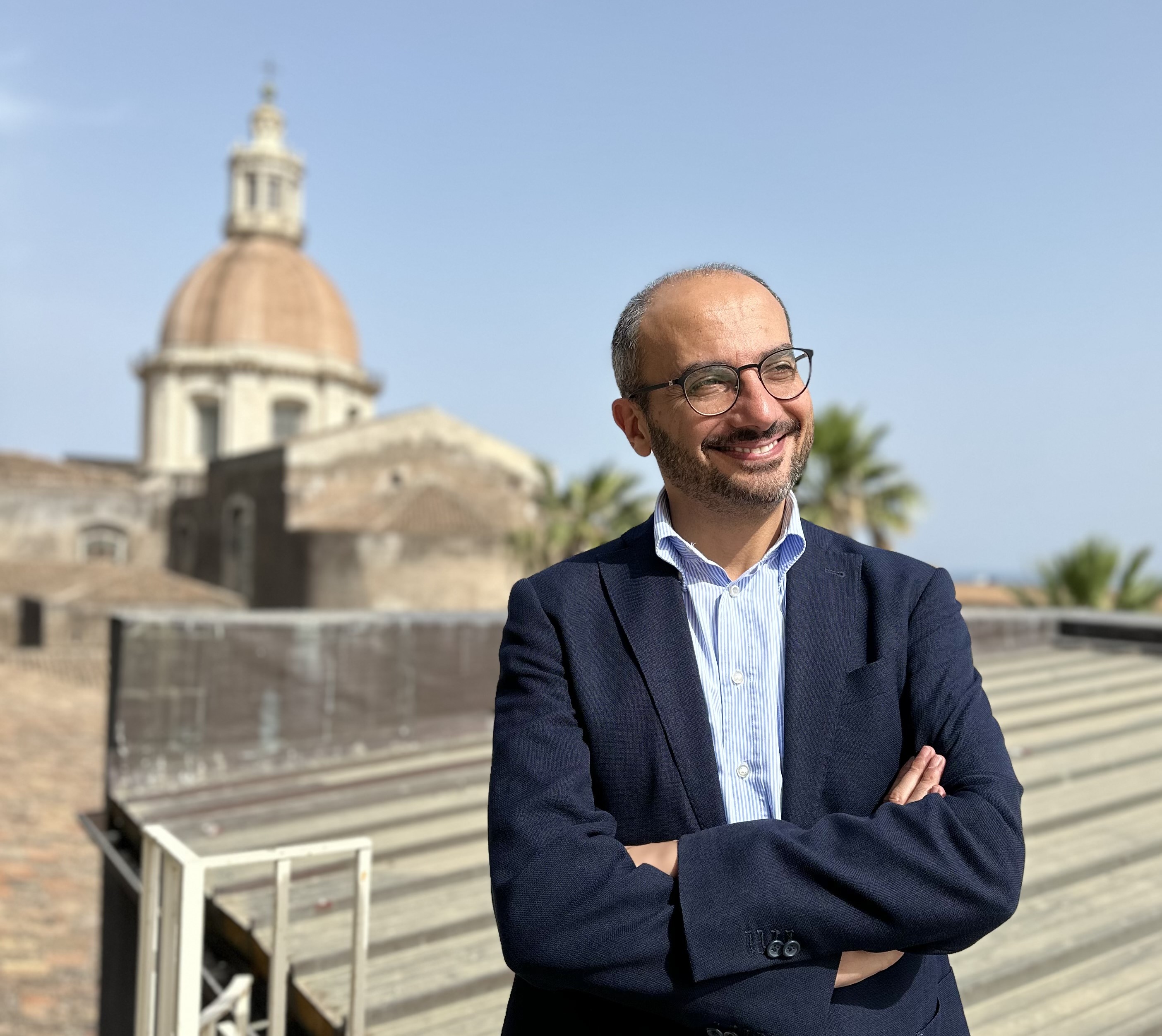
Giuseppe PALAZZOLO
Giuseppe Palazzolo is Associate Professor of Contemporary Italian Literature (sector LICO-01/A) at the Department of Humanities (DISUM), University of Catania. He holds a Laurea (BA) in Classical Letters and a Laurea Specialistica (MA) in Modern Philology, both from the University of Catania, and a PhD in Italian Studies (Lexicography and Semantics of the European Literary Language) from the same institution. In November 2023 he obtained the National Scientific Habilitation (ASN) qualifying him for Full Professorship in Contemporary Italian Literature (SC 10/F2), awarded by the Italian Ministry of University and Research (MUR).
His research focuses on twentieth- and twenty-first-century Italian literature, with particular attention to literary canon formation, authorship, the relationship between literature and visual culture, and the application of digital methods to literary studies. He has published monographs on Alessandro Manzoni and dedicated sustained research to Luigi Pirandello, Franco Fortini, and Umberto Eco. In the field of digital humanities, he is a member of the research team of the National Digital Edition of Luigi Pirandello's complete works (dir. A. Sichera – A. Di Silvestro; editorial team) and collaborates on the Verismo Digitale project within the CHANGES extended partnership (Spoke 3 — digital libraries, archives and philology). He is a member of the Scientific Council of the CINUM (Centre for Digital Humanities), University of Catania.
He serves as Unit PI (Principal Investigator for the University of Catania research unit) within the PRIN 2022 PNRR project "Memory and the Mezzogiorno (MeMo). A Literary Map from 1945 to the Present" (national coordinator: Bernardo De Luca, Università Federico II, Naples) and as a member of the leading unit of the PRIN 2022 project "PAVES-e. Towards an Archive-Edition of Pavese's Work" (national coordinator: Antonio Sichera, University of Catania; 2023–2026). Between 2003 and 2010 he participated in several nationally funded research projects (PRIN).
Since December 2023 he is a member of the Executive Board of the Alta Scuola di Formazione degli Insegnanti (ASFI — Advanced School for Teacher Training) of the University of Catania, and Director of the teacher-training pathways A011 (Italian Literature and Latin), A012 (Italian Literature, Secondary Schools) and A013 (Italian Literature, Latin and Greek). He serves, together with Prof.ssa Daria Motta, as delegate for continuing education and school relations at DISUM, and for the coordination of the research strand "Didattica delle discipline" (Literature Teaching). He is a tutor and member of the Faculty Board of the PhD Programme in Scienze dell'interpretazione (Interpretive Studies).
He is a member of MOD (Italian Society for the Study of Literary Modernity), AIUCD (Italian Association for Digital Humanities and Culture), ADI (Association of Italianists), AIPI (International Association of Italian Studies Professors), SIS (Society for Italian Studies), and the Europäisches Pirandello Zentrum. He is the responsible academic for the Erasmus+ institutional agreements with Sorbonne Université (Paris) and Université Paul-Valéry Montpellier III. He is a member of the Editorial Board of Siculorum Gymnasium. A Journal for the Humanities, of the series Intus-legere (Duetredue edizioni), and of the Scientific Committees of the journals La Modernità della Scuola and Oltre lo specchio. Between 2002 and 2009 he collaborated on the Italian literature anthology series coordinated by Giorgio Bárberi Squarotti (Edizioni Atlas).
Giuseppe Palazzolo's research is organised around five main and interconnected areas.
Twentieth- and Twenty-First-Century Italian Literature. His work has focused on key authors of Italian literary modernity — Alessandro Manzoni, Luigi Pirandello, Franco Fortini, Umberto Eco, and Cesare Pavese — examined through semantic, hermeneutic, lexicographic, and computational methods. His doctoral dissertation on Manzoni's poetry resulted in a two-volume concordance and was followed by two further monographs on the same author. He has dedicated sustained research to Pirandello, with particular attention to the relationship between writing, the gaze, and modernity, as explored in the Quaderni di Serafino Gubbio operatore. His research on Franco Fortini, funded by the competitive grant FoNTE (PIACERI, 2020–21), investigated the intersection of politics, prophecy, and poetic writing. His studies on Umberto Eco have explored gnostic narrative, the illustrated postmodern novel, apocalyptic fiction, and the boundaries between autobiography and invention.
Southern Italian Literature and Questions of Culture. A more recent line of research, developed within the PRIN 2022 PNRR project MeMo (Memory and the Mezzogiorno. A Literary Map from 1945 to the Present, coord. B. De Luca, Università Federico II, Naples), examines the relationships between memory, identity, and the literary representation of the Italian South from the postwar period to the present, with attention to the intersections of literature, subalternity, and popular cultural forms.
Biofictional Narratives and Authorship. A further area of inquiry concerns forms of writing that hybridise biography, autobiography, and fiction, and questions of authorship in contemporary narrative, approached from a comparative perspective.
Digital Humanities. In the field of digital humanities, he collaborates on the National Digital Edition of Luigi Pirandello's complete works (CINUM, dir. A. Sichera – A. Di Silvestro), on the Verismo Digitale project (CHANGES extended partnership, Spoke 3 — digital libraries, archives and philology), and on the PAVES-e project (digital archive-edition of Cesare Pavese's works, PRIN 2022, coord. A. Sichera). He has conducted research on the computational reading of literary texts — distant reading, semantic analysis, and literary databases — and on models of writing and reading in the digital text environment.
Literature Teaching and Teacher Training. A distinct and structured area of research concerns the teaching of Italian literature, with particular attention to the relationship between literary tradition, new technologies, and the professional formation of secondary school teachers. He has published essays on the literary textbook in the digital age, on the use of computational tools in literature teaching, and on methodologies for teacher training. He serves as local representative for Sicily (Catania) of MOD Scuola, the programme of the Italian Society for the Study of Literary Modernity (MOD) dedicated to fostering dialogue between university research and secondary school teaching (national coordinator: M. Tortora, Sapienza University of Rome). He is a member of the scientific committee of the journal La Modernità della Scuola, and has organised and led teacher training and continuing education courses within MOD, ADI-SD, and ASFI (University of Catania).